
Hon. Roland Hache
Marysville Place
P. O. Box 6000
Fredericton, NB
E3B 5H1
Canada
November 30, 2009
Dear Hon. Roland Hache
During our meeting on Monday, November 16, 2009 we asked that the 21 passenger MFAV owned by Bathurst High School be taken off the road until the issue of winter tire vs all season tires is resolved to the satisfaction of Transport Canada.
We have since been told that Bathurst High School has taken the 21 passenger MFAV off the road until such time as Transport Canada has come to a decision in this matter and your consulting engineer, Mr. David Hoar, has the research data to back up his position on what type of tires should be on this 21 passenger MFAV.
In that regard, we are asking for your confirmation that BHS's 21 passenger MFAV has been taken off the road until a decision on the use of winter vs all season tires has been reached. If this is the case, then we are concerned about all the other 21 passenger MFAVs in all school districts of the province. In light of the Bathurst situation, will they also be taken off the road until a final decision has been made? Given the liability considerations, it would seem to us that all of these vehicles should be taken off the road immediately.
At our meeting you will recall that we asked to be involved in the process and to be made aware of the steps being taken to undertake the research required. On Friday, November 27, 2009, we were sent a document from Mr. David Hoar "Usage of winter tires designated tires on passenger vehicles and light busses" dated November 22, 2009 (attached). While this document certainly gives us an understanding of Mr. Hoar's opinion, it does not cite any research data, studies or actual testing. In our view, Mr. Hoar's letter points to the need for actual testing of this type of 21 passenger MFAV under New Brunswick's winter highway conditions.
We urge you, as Minister of Education, to request that NB's Department of Transportation undertake its own studies as a supplement to the studies that we understand will also be undertaken by the federal Department of Transport at your request. We do not need to remind you that this tire issue needs to be resolved quickly so that children can participate in after school activities knowing that the proper tires are installed for safe travel during the winter months.
Thanking you advance for your response to this letter.
Yours sincerely,
cc. Premier Shawn Graham
Denis Landry, NB Minister of Transportation
Monday, November 30, 2009
Friday, November 27, 2009
Response from David Hoar, Engineering Consultant, NB Department of Transportation
On November 27, we were forwarded this letter from David Hoar by Charlotte Valley, of the NB Department of Transportation.
(Click here to view PDF of David Hoar's letter dated November 22, 2009) or read the text of the letter below.
The letter was written by David Hoar of Motion Design Assoc., based in Fredericton. Mr. Hoar is a paid consultant who advises the Department of Transportation. He was asked his professional opinion on the use of mixed tires on the 21 passenger MFAVs after we raised the issue with the Department of Education and Transportation and brought our concerns to the media. We asked both Departments for scientific research data supporting Mr. Hoar's view and this is what we got.
In this letter explaining the rationale behind his belief that mixed tires are suitable for this type of vehicle, Mr. Hoar does not cite a single scientific research study nor does he provide any research data to support his view.
Instead, all we hear is his opinion that mixed tires are suitable for 21 passenger MFAVs, which is in complete contradiction to the expert opinion of Nigel Mortimer of Transport Canada and John Mahler of Wheels Magazine, among numerous other experts we consulted in the course of our own research.
Who would you believe?
____
Motion Design Assoc Ltd.
Design and Consulting Engineers
PO Box 1074 Station A
Fredericton NB
E3B 5G2
830 Hanwell Road
Fredericton, NB
Tel: 506-458-9017
Fax: 506-458-9741
22 November 2009
Province of New Brunswick
Department of Transportation
Vehicle Management Agency
1050 College Hill Road
PO Box 6000
Fredericton, NB
E3B 5H1
Att: Charlotte Valley, Director of Operations
RE: USAGE OF WINTER DESIGNATED TIRES ON PASSENGER VEHICLES AND LIGHT BUSSES
Confirming our conversations with respect to the usage of Winter Designated Tires on Dept of Education administered vehicles, we had previously reviewed the policy used by Education and concurred with the policy contents.
The recommendation was to ensure all front wheel drive, all wheel drive, and four wheel drive vehicles be equipped with Winter designated Tires, carrying the “Snow Flake and Mountain Peak” symbol, at all wheel positions, For light busses based on LT Chassis, and larger busses, the recommendation was to keep the policy in effect and install such tires on the drive position only. Steer positions should continue to be equipped with appropriate rib style tires that are less aggressive than on the drive positions.
We agree that for heavy snow conditions there will be an improvement in steering and braking abilities at lower or urban speeds with winter tires installed in all positions, however for weather controlled operational profiles that include significant highway speed usage, we concur and recommend that the winter traction tires be confined to the drive positions, as in virtually all commercial and highway usage vehicles that are rear drive.
There is a common concern with highway speed usage in low traction conditions for the risk of loss of lateral vehicle stability during an evasive or corrective maneuver, such as the sudden encounter with slush. Black ice, snow rutting. Etc. The loss of control concern in question is that of rear end skidding, or “oversteer”. This situation is identifiable and can present on perfectly straight sections of highway within legal posted speeds. Vehicle operators can drive vehicles with appropriate caution and procedures to address normal steering, stopping, and braking situations when dealing with normal intersection and turning situations. The sudden loss of lateral control risk is difficult to anticipate and address. This is an identifiable concern and numerous incidents occur on public highways each year that cause serious injuries and/ or loss of life. These incidents arise from loss of vehicle control or “oversteer” situations in both wet highways in warmer seasons and snow and ice conditions in winter.
Front wheel drive vehicles have historically been more prone to such situations, and manufacturers of vehicles, vehicle systems, and tire manufacturers have introduced significant developments including, Anti Lock brakes, Electronic Stability control systems, and appropriate rain and winter adaptive tires for this common end. The objective is to allow the operator to maintain vehicle directional control in adverse conditions, in particular to prevent or limit “oversteer” in corrective actions.
Rear drive vehicles have an inherent tendency to resist the “oversteer” tendency common to front wheel drive vehicles, and can be helped to maintain the characteristic by ensuring rear traction dominance. In low traction conditions, high traction tires on steer positions can, in evasive and correctional actions, risk excessive front end braking or steering forces that can cause excessive vehicle rotation that can induce excessive rear tire slip angles and rapid loss of directional control.
We would agree that “steer” position and “drive” position winter designated tires that certain manufacturers market in Europe would be ideal and suitable for winter conditions. However as in heavy truck tires the same “drive” traction tires on all positions does not appear to be recommended for reasons of reducing the rear traction dominance for low traction winter conditions.
We agree that Winter designated tires for all positions will produce improvements at lower identified speeds, however with the identifiable risk of control of loss during highway evasive or corrective actions, we will be changing our recommendation for winter tire usage on the drive only positions to maintain rear traction dominance. These vehicles in question that are operated under control of the Department of Education are used in weather condition controlled operations, and exposure to the majority of low traction situations can be controlled.
Improvements are continually being made in both vehicle safety systems and tire technology that will ultimately address these concerns. We have requested to be privilege to the documentation and testing results upon with Transport Canada has based their general recommendation that “Where winter designated tires are available they should be used on all wheel positions”, to offset our concerns.
D. Hoar P. Eng.
(Click here to view PDF of David Hoar's letter dated November 22, 2009)
(Click here to view PDF of David Hoar's letter dated November 22, 2009) or read the text of the letter below.
The letter was written by David Hoar of Motion Design Assoc., based in Fredericton. Mr. Hoar is a paid consultant who advises the Department of Transportation. He was asked his professional opinion on the use of mixed tires on the 21 passenger MFAVs after we raised the issue with the Department of Education and Transportation and brought our concerns to the media. We asked both Departments for scientific research data supporting Mr. Hoar's view and this is what we got.
In this letter explaining the rationale behind his belief that mixed tires are suitable for this type of vehicle, Mr. Hoar does not cite a single scientific research study nor does he provide any research data to support his view.
Instead, all we hear is his opinion that mixed tires are suitable for 21 passenger MFAVs, which is in complete contradiction to the expert opinion of Nigel Mortimer of Transport Canada and John Mahler of Wheels Magazine, among numerous other experts we consulted in the course of our own research.
Who would you believe?
____
Motion Design Assoc Ltd.
Design and Consulting Engineers
PO Box 1074 Station A
Fredericton NB
E3B 5G2
830 Hanwell Road
Fredericton, NB
Tel: 506-458-9017
Fax: 506-458-9741
22 November 2009
Province of New Brunswick
Department of Transportation
Vehicle Management Agency
1050 College Hill Road
PO Box 6000
Fredericton, NB
E3B 5H1
Att: Charlotte Valley, Director of Operations
RE: USAGE OF WINTER DESIGNATED TIRES ON PASSENGER VEHICLES AND LIGHT BUSSES
Confirming our conversations with respect to the usage of Winter Designated Tires on Dept of Education administered vehicles, we had previously reviewed the policy used by Education and concurred with the policy contents.
The recommendation was to ensure all front wheel drive, all wheel drive, and four wheel drive vehicles be equipped with Winter designated Tires, carrying the “Snow Flake and Mountain Peak” symbol, at all wheel positions, For light busses based on LT Chassis, and larger busses, the recommendation was to keep the policy in effect and install such tires on the drive position only. Steer positions should continue to be equipped with appropriate rib style tires that are less aggressive than on the drive positions.
We agree that for heavy snow conditions there will be an improvement in steering and braking abilities at lower or urban speeds with winter tires installed in all positions, however for weather controlled operational profiles that include significant highway speed usage, we concur and recommend that the winter traction tires be confined to the drive positions, as in virtually all commercial and highway usage vehicles that are rear drive.
There is a common concern with highway speed usage in low traction conditions for the risk of loss of lateral vehicle stability during an evasive or corrective maneuver, such as the sudden encounter with slush. Black ice, snow rutting. Etc. The loss of control concern in question is that of rear end skidding, or “oversteer”. This situation is identifiable and can present on perfectly straight sections of highway within legal posted speeds. Vehicle operators can drive vehicles with appropriate caution and procedures to address normal steering, stopping, and braking situations when dealing with normal intersection and turning situations. The sudden loss of lateral control risk is difficult to anticipate and address. This is an identifiable concern and numerous incidents occur on public highways each year that cause serious injuries and/ or loss of life. These incidents arise from loss of vehicle control or “oversteer” situations in both wet highways in warmer seasons and snow and ice conditions in winter.
Front wheel drive vehicles have historically been more prone to such situations, and manufacturers of vehicles, vehicle systems, and tire manufacturers have introduced significant developments including, Anti Lock brakes, Electronic Stability control systems, and appropriate rain and winter adaptive tires for this common end. The objective is to allow the operator to maintain vehicle directional control in adverse conditions, in particular to prevent or limit “oversteer” in corrective actions.
Rear drive vehicles have an inherent tendency to resist the “oversteer” tendency common to front wheel drive vehicles, and can be helped to maintain the characteristic by ensuring rear traction dominance. In low traction conditions, high traction tires on steer positions can, in evasive and correctional actions, risk excessive front end braking or steering forces that can cause excessive vehicle rotation that can induce excessive rear tire slip angles and rapid loss of directional control.
We would agree that “steer” position and “drive” position winter designated tires that certain manufacturers market in Europe would be ideal and suitable for winter conditions. However as in heavy truck tires the same “drive” traction tires on all positions does not appear to be recommended for reasons of reducing the rear traction dominance for low traction winter conditions.
We agree that Winter designated tires for all positions will produce improvements at lower identified speeds, however with the identifiable risk of control of loss during highway evasive or corrective actions, we will be changing our recommendation for winter tire usage on the drive only positions to maintain rear traction dominance. These vehicles in question that are operated under control of the Department of Education are used in weather condition controlled operations, and exposure to the majority of low traction situations can be controlled.
Improvements are continually being made in both vehicle safety systems and tire technology that will ultimately address these concerns. We have requested to be privilege to the documentation and testing results upon with Transport Canada has based their general recommendation that “Where winter designated tires are available they should be used on all wheel positions”, to offset our concerns.
D. Hoar P. Eng.
(Click here to view PDF of David Hoar's letter dated November 22, 2009)

Olympic Flame Comes to Bathurst High School Memorial for BHS Phantoms
We just found out that the Olympic Flame will be making a short stop on Saturday morning at 7 am at the Bathurst High School's memorial to our boys. There will be a moment of silence before the Torch continues on its way to Dalhousie and Quebec.
We are honoured that the Vancouver Olympic Organizing Committee has included our boys in the Olympic Torch Relay.
We are honoured that the Vancouver Olympic Organizing Committee has included our boys in the Olympic Torch Relay.
Tuesday, November 24, 2009
Letter from Gary Spencer, NB DOT to GoodYear Tire Asking For OPINION on Winter Tires
Here is the email sent to GoodYear on November 24 2009 by Gary Spencer of the NB Department of Transportation seeking Goodyear's opinion on the use of winter tires.
You will note the following in his letter to Goodyear:
1. The Multi Function Activity Vehicles (MFAVs) have been variously called "small school buses" "20 passenger buses" "passenger buses" and "bus" even though they are not a "bus".
2. Mr. Spencer admits that the MFAV is a new vehicle in the provincial fleet and because they didn't have a policy per se, they simply implemented the tire policy for yellow school buses (even though this is not a bus).
"This size of bus had not previously been utilized in our fleet and our standard school bus tire policy was applied, that is ribbed/steering tires on the steering axle and winter or traction tires on the drive axle."
______
From: Spencer, Gary (DOT/MDT)
Sent: Tuesday, November 24, 2009 4:13 PM
To frank.migneault@goodyear.com
Subject: Opinion regarding the usage of winter tires on steering axles of small school buses.
Thank you for contacting me to offer your assistance in the selection of the safest tire options for our 20 passenger buses. As a tire manufacturer we appreciate and value your opinion on such matters.
Recently the Province of New Brunswick has taken ownership of some twenty passenger buses which are rear wheel drive construction utilizing one ton chassis'. This size of bus had not previously been utilized in our fleet and our standard school bus tire policy was applied, that is ribbed/steering tires on the steering axle and winter or traction tires on the drive axle. Recently some individuals and tire manufacturers have suggested that RAC certified winter tires should be utilized on all axles as these buses have 16" wheels and "winter" tires are available in that size.
These buses travel as "inter-city" buses, that is, the vast majority of travel will be from one city to another, on highway, with minimal urban travel. The policy for utilization of these buses is such that travel during inclement weather is prohibited. With that said, some travel during snowfall will inevitable occur.
The province has retained the services of an independent Automotive Engineer to provide advise to us on this very important matter. I have attached his report for your review. In summary, Mr. Hoar recommends that on rear wheel drive vehicles we should maintain rear axle traction dominance by installing traction/winter tires on the drive/rear axle and ribbed tires on the front/steering axle. His contention is that rear wheel drive vehicles equipped with traction/steering tires and traveling at highway speeds inherently reduce the risk of oversteer loss of directional stability, and allow the driver a better chance of maintaining or recovering directional control in a evasive or corrective action.
I would appreciate receiving your written opinion regarding the safest tire set-up for these buses. Please feel free to contact me for additional information at (506) 453-2601
Your timely response would be very much appreciated.
Gary Spencer, P. Eng.
Asst Director Operations
Vehicle Management Agency
(See Attached David Hoar's Motion Design Report)
___
For the full text of David Hoar's letter, click here
You will note the following in his letter to Goodyear:
1. The Multi Function Activity Vehicles (MFAVs) have been variously called "small school buses" "20 passenger buses" "passenger buses" and "bus" even though they are not a "bus".
2. Mr. Spencer admits that the MFAV is a new vehicle in the provincial fleet and because they didn't have a policy per se, they simply implemented the tire policy for yellow school buses (even though this is not a bus).
"This size of bus had not previously been utilized in our fleet and our standard school bus tire policy was applied, that is ribbed/steering tires on the steering axle and winter or traction tires on the drive axle."
______
From: Spencer, Gary (DOT/MDT)
Sent: Tuesday, November 24, 2009 4:13 PM
To frank.migneault@goodyear.com
Subject: Opinion regarding the usage of winter tires on steering axles of small school buses.
Thank you for contacting me to offer your assistance in the selection of the safest tire options for our 20 passenger buses. As a tire manufacturer we appreciate and value your opinion on such matters.
Recently the Province of New Brunswick has taken ownership of some twenty passenger buses which are rear wheel drive construction utilizing one ton chassis'. This size of bus had not previously been utilized in our fleet and our standard school bus tire policy was applied, that is ribbed/steering tires on the steering axle and winter or traction tires on the drive axle. Recently some individuals and tire manufacturers have suggested that RAC certified winter tires should be utilized on all axles as these buses have 16" wheels and "winter" tires are available in that size.
These buses travel as "inter-city" buses, that is, the vast majority of travel will be from one city to another, on highway, with minimal urban travel. The policy for utilization of these buses is such that travel during inclement weather is prohibited. With that said, some travel during snowfall will inevitable occur.
The province has retained the services of an independent Automotive Engineer to provide advise to us on this very important matter. I have attached his report for your review. In summary, Mr. Hoar recommends that on rear wheel drive vehicles we should maintain rear axle traction dominance by installing traction/winter tires on the drive/rear axle and ribbed tires on the front/steering axle. His contention is that rear wheel drive vehicles equipped with traction/steering tires and traveling at highway speeds inherently reduce the risk of oversteer loss of directional stability, and allow the driver a better chance of maintaining or recovering directional control in a evasive or corrective action.
I would appreciate receiving your written opinion regarding the safest tire set-up for these buses. Please feel free to contact me for additional information at (506) 453-2601
Your timely response would be very much appreciated.
Gary Spencer, P. Eng.
Asst Director Operations
Vehicle Management Agency
(See Attached David Hoar's Motion Design Report)
___
For the full text of David Hoar's letter, click here
Monday, November 23, 2009
Department of Education on the Defensive: Sends Communications Director to Defend Position on Wheels website

We couldn't help but notice Valerie Kilfoil, the Director of Communications for New Brunswick's Department of Education, posting comments to John Mahler's article about winter tires on the Wheels.ca website in an attempt to diminish his findings. (Click here to read the article).
If it wasn't so pathetic, it would be laughable, unfortunately, nothing about this entire situation is funny.
It's utterly tragic and the sad part is that the Department is setting itself up for another tragedy by sticking to the "party line" and refusing to listen to what all the industry experts are saying. One doesn't have to be an expert in Greek tragedies to know that pride is the downfall of man (and women too).
Here's are Valerie Kilfoil's postings on the Wheels.ca website.
Tire expert David Hoar explains the use of winter tires on the back and ribbed on the front for rear wheel drive vehicles to CBC Radio: "There's slightly more traction on the rear to keep the straightening effect. Where we have this identifiable condition on the highway, a loss of lateral control on the highway, we usually end up in one or two things happening. The vehicle will either end up heading for the ditch or will head over into the other lane. Very seldom does it ever stay straight once it loses its lateral control. The ditch is one thing. Going over to the opposite lane can be very, very dangerous. And very often, the vehicle will present sideways to oncoming traffic. That is the identifiable condition which with we are concerned with." The Government of NB has asked Transport Canada for a clear directive on the safest tires for rear wheel vehicles used for mainly highway driving and will accept thier recommendation. Valerie Kilfoil, Department of Education
Submitted by Valerie Kilfoil at 3:00 PM Wednesday, November 18 2009
The Government of New Brunswick is following the advice of experts. Experts agree in most instances four winter tires are safest. However, when tire experts (particilarly motion and design engineers)are asked specifically about rear wheel, highway driven vehicles, the industry standard is winter tires on the back and ribbed tires on the front. Highway tractor, inner city buses, delivery trucks or anything that is rear wheel drive in Canada use winter tires on the back and ribbed on the front. The busses New Brunswick uses to transport students to extra curricular activites are rear wheel drive vehicles. Valerie Kilfoil, communications, department of Education
Submitted by Valerie Kilfoil at 2:59 PM Wednesday, November 18 2009
Mahler: Winter tires lesson lost already?

NOTE: This article originally appeared on line on Wednesday, November 18, 2009. (Click here to read original article on this website). However, late Tuesday, November 17, following our meeting with the Minister of Education Roland Hache on Monday, November 16, Valerie Kilfoil, Communications Director for the New Brunswick Department of Education announced that the Department would follow Transport Canada's lead in the winter tire issue. The New Brunswick media followed up by interviewing Mr. David Hoar, a Fredericton based engineering consultant who has been hired by the Department of Education to advise on winter tires. Mr. Hoar insisted that he was right and everyone else was wrong. So Wheel's Magazine journalist John Mahler revised the on line article to include a new interview with Mr. Hoar.
The result was the same. Internationally recognized automotive tire expert John Mahler and all the industry experts he interviewed still say Mr. Hoar and the NB Department of Education are wrong.
____
REVISED ARTICLE WITH INTERVIEW WITH DAVID HOAR
 Mothers of New Brunswick teens killed in school van crash shocked to find inquest directives not followed
Nov 21, 2009
by John Mahler, Wheels Magazine
Click here to read the story in Wheels Magazine
Have you ever looked at the tires on your child's school minibus?
I haven't either.
Three New Brunswick women have and they didn't like what they saw, and they are very, very angry.
And so am I.
Isabelle Hains, Marcella Kelly and Ana Acevedo all lost sons in the tragic crash of a 15-passenger school van in which seven members of the Bathurst High School basketball team and one teacher died. The school van collided with a transport truck in January 2008.
The pair lobbied for an inquest, so the results would help ensure this kind of tragedy would never recur. Eventually they succeeded.
One of the many recommendations coming out of the inquest was that all school buses be equipped with winter tires during the winter. The mothers thought they had won an important victory for children's safety.
So imagine their shock last month when they saw that the minibus used to transport students to extracurricular activities at Bathurst High School was not fully equipped with winter tires. School District 15 had equipped the bus with Hakkapeliitta winter tires on the dual rear wheels and Michelin LTX all-season (light truck) tires on the front wheels.
"It would appear they haven't learned their lesson," was Hains' reaction.
Hains did some research and found out that, to be effective, winter tires are required on all wheels. She checked with experts including Nigel Mortimer of Transport Canada and the Star's Tire Guy – me. We both advised her that, yes, winter tires are required on all wheels for maximum safety.
An easy fix. Notify the board and they'll change the tires, you'd think.
Wrong! The superintendent of the board, John McLaughlin, replied that the board had met the directive from the New Brunswick ministry of education that applies to much larger school buses. But that directive left a loophole so big you could drive a minibus through it.
Transport Canada's Mortimer wrote to the board, pointing out the error. I supplied Hains with research material to help her cause. The board politely told Mortimer to mind his own business. Transport Canada has no provincial jurisdiction on the bus tire issue.
I spoke with David Hoar, an independent consultant who is contracted to the New Brunswick government to provide tire expertise.
He agreed that for four-wheel-drive or all-wheel-drive vehicles, "by all means, (they) should be equipped with comfortable traction tires at all four corners, there's no question."
But he does not agree on winter tires on all positions on rear wheel drive vehicles.
"If you do back off the throttle, the vehicle has a tendency to brake from the rear and keep that vehicle straight," he says.
"There is the condition of an innocent driver going below speed limit on a highway, who hits a patch of ice or slush, backing off the throttle keeps the vehicle straight, and if it takes him two or three seconds to recover that vehicle, he has time to regain control.
"If you put snow tires on, you improve your traction, you improve your braking. At low speed, yes, but there are no studies that we can obtain that prove that this is true at highway speeds."
In other words, at higher speeds he feels the lack of front grip is better as it gives the driver more time to solve the problems.
He went on to say that "it sounds good to say, `let's put snow tires all around.' But where we have this identifiable condition on the highway, a loss of lateral control on the highway, we usually end up in one or two things happening: The vehicle will either end up heading for the ditch or will head over into the other lane. Very seldom does it ever stay straight once it loses its lateral control.
"If I am incorrect, prove me wrong with the data. If the tire companies have the data, Transport Canada can force them to give access."
I checked with contacts at the tire companies to make sure we were on the right track.
Michelin North America's Ron Margadonna, senior technical marketing manager, replied: "It is clear that the tire industry recommends winter tires on ALL wheel positions for safe driving in winter conditions.
"However, if a consumer so chooses to only purchase two winter tires (based on a four-wheel- or rear-drive vehicle only), these tires should be installed on the rear axle of the vehicle. This would also apply on a bus.
"In addition, the consumer needs to know that by not installing winter tires on all wheel positions, a traction imbalance results, which can create a vehicle stability issue, especially when cornering or during an emergency manoeuvring or braking scenario."
Toyo Tire's Canadian public relations manager, James de Chavez replied: "The theory is the same for a car as it is for a small bus. Therefore, winter tires need to be on every axle to gain the true benefits received from a winter tire.
"An LT (light truck) metric tire will not achieve what a true winter tire can in snowy conditions, therefore mixing and matching them is not recommended."
Bridgestone North America's Guy Walenga, director of engineering, commercial product technology, also found the board's decision strange.
"There is more than one answer to this question," he replied. He likened the all-season-on-the-front setup to a large tractor-trailer unit that, in the winter, typically uses winter tires for traction on the drive wheels only, but which is a much different vehicle.
"A front rib tire setup may be okay for a pro driver," he said. "On the mini-bus, is this the best setup? No. In braking on snow, when weight transfers forward, winters on the front will stop better than all-seasons. In a corner when grip is lost, understeer is the best of a bad situation."
Walenga offered the example of the worst-case scenario: "The driver is enroute, it starts snowing, the driver has a headache, the kids are screaming in back – two winter tires on front are better than Excedrin. For non-pro drivers, winter tires on the front will give a driver more confidence. Confidence makes for a better driver."
And I contacted Joerg Burfien, Continental Tire's director of R&D for the Americas, who said that Continental has conducted a great deal of "mixed fitment" tire testing.
"With all-seasons in the front and winter tires on the (dual) rear axle – stopping will likely be an issue! You will for sure not be able to stop as fast as you're able to accelerate.
"Two simple reasons for this: traction for all-season tires in snow is much lower and when you brake your weight is shifting forward, so the increased traction in the rear is not helping much. Actually, you can't expect more than 25 per cent stopping power to come from the rear anyway.
"The same is valid for steering or steering response. You will have a very solid rear axle and very limited traction on the front which will promote under-steering conditions. So not really the safest option.
"Continental Tire's position is a strong recommendation to switch to winter tires on all axles as soon as temperatures consistently drop below 7 C."
So it is clear that four winter tires on a bus – or any vehicle for that matter – make a profound difference.
Vehicle braking capability is affected by the imbalance of winter and all-season tires mounted at the same time on the same vehicle.
Tire experts have come to this conclusion, and it's not just because they want to sell more tires. There is serious technology involved in these product decisions and the tires have been created to act in tandem back and front.
It's a no-brainer these days to understand this premise.
The policy is just plain wrong.
John Mahler is Wheels' tire expert.
He can be reached at thetireguy_1 @ hotmail.com, or share your thoughts with readers at wheels@thestar.ca
Click here to read the story in Wheels Magazine
Toronto Star
Saturday, November 21, 2009
NB Dept. of Education Watch This: "Extra Margin of Safety" in Winter Tire Demonstration by George Iny of the Automotive Protection Assocation
We were advised today by one of Canada's leading tire experts (more on him later) to watch this winter tire demonstration by George Iny, President of the Automotive Protection Association, which is based in Montreal.
Mr. Iny is well known in the winter tire circles for his advocacy work and this series of six videos explains in great detail how critical it is to have four winter tires - or don't bother at all.
We can't understand why the New Brunswick Department of Education chooses to ignore the advice of experts who know winter tires better than anybody else in Canada.
Will we have to go through another crash like the one that killed our sons nearly two years ago before they realize that they should be listening to experts like George Iny and others across Canada who actually know what they are talking about?
But no, the New Brunswick Department of Education refuses to listen to expert opinion when it comes to winter tires. At least we'll admit we're not experts, but we're doing our research and the experts we've spoken to so far are all telling us that in winter, you use winter tires. Not two all season tires on the front of the Bathurst High School's new multi-function vehicle and four winters on the back. Winter tires on all four axle. What is it about all winter tires that the NB Department of Education doesn't get?
We challenge the Department of Education to tell us who is giving them their advice on school transportation policies that say two all seasons in the front and winter tires in the back of these multi-function vehicles is acceptable? Everyone we have spoken to says that's the OLD WAY OF THINKING. Today, the consensus is that all wheels be fitted with winter tiress. End of story. Yet, the NB Department of Education figures it's smarter than everyone else and refuses to put winter tires on the front wheels of the brand new multi-function vehicles that are transporting children to extra-curricular activities. For what? The sake of $200? The four rear winter tires were graciously donated to the Bathurst High School. We are actually getting to meet with the Minister of Education, Roland Hachey, in November, we will ask, are our children's lives not worth $200?
"The results are actually very dramatic, surprising in even these low speed demonstrations," says Mr. Iny in the final segment of his winter tire demonstration. "The winter equipped tire vehicle always breaked better, almost always went through the corner quite a lot more cleanly than the all season equipped tire. And when you're driving every day, you won't see those differences every day but once in a while, you'll need the extra margin of safety from the better tire and you've got to be equipped for that."
What more can we say?
For more information on the Automotive Protection Association and George Iny, go to the ASA website at www.asa.ca.
Tomorrow, more on winter tires from one of Canada's top experts who says that by putting two all season tires on the front of the new Bathurst High School multi function vehicles and winter tires on the back the Department of Education has actually made the vehicle "UNSAFE".
To quote: "It's better to have no winter tires at all" than to have that combination in winter. Hmmm. Is anybody at the NB Department of Education listening? Maybe it's time to start thinking about changing the Department's policy on winter tires altogether.
Mr. Iny is well known in the winter tire circles for his advocacy work and this series of six videos explains in great detail how critical it is to have four winter tires - or don't bother at all.
We can't understand why the New Brunswick Department of Education chooses to ignore the advice of experts who know winter tires better than anybody else in Canada.
Will we have to go through another crash like the one that killed our sons nearly two years ago before they realize that they should be listening to experts like George Iny and others across Canada who actually know what they are talking about?
But no, the New Brunswick Department of Education refuses to listen to expert opinion when it comes to winter tires. At least we'll admit we're not experts, but we're doing our research and the experts we've spoken to so far are all telling us that in winter, you use winter tires. Not two all season tires on the front of the Bathurst High School's new multi-function vehicle and four winters on the back. Winter tires on all four axle. What is it about all winter tires that the NB Department of Education doesn't get?
We challenge the Department of Education to tell us who is giving them their advice on school transportation policies that say two all seasons in the front and winter tires in the back of these multi-function vehicles is acceptable? Everyone we have spoken to says that's the OLD WAY OF THINKING. Today, the consensus is that all wheels be fitted with winter tiress. End of story. Yet, the NB Department of Education figures it's smarter than everyone else and refuses to put winter tires on the front wheels of the brand new multi-function vehicles that are transporting children to extra-curricular activities. For what? The sake of $200? The four rear winter tires were graciously donated to the Bathurst High School. We are actually getting to meet with the Minister of Education, Roland Hachey, in November, we will ask, are our children's lives not worth $200?
"The results are actually very dramatic, surprising in even these low speed demonstrations," says Mr. Iny in the final segment of his winter tire demonstration. "The winter equipped tire vehicle always breaked better, almost always went through the corner quite a lot more cleanly than the all season equipped tire. And when you're driving every day, you won't see those differences every day but once in a while, you'll need the extra margin of safety from the better tire and you've got to be equipped for that."
What more can we say?
For more information on the Automotive Protection Association and George Iny, go to the ASA website at www.asa.ca.
Tomorrow, more on winter tires from one of Canada's top experts who says that by putting two all season tires on the front of the new Bathurst High School multi function vehicles and winter tires on the back the Department of Education has actually made the vehicle "UNSAFE".
To quote: "It's better to have no winter tires at all" than to have that combination in winter. Hmmm. Is anybody at the NB Department of Education listening? Maybe it's time to start thinking about changing the Department's policy on winter tires altogether.
Wednesday, November 18, 2009
Wheels Magazine: Winter tire recommendation means four, not two

Mothers of New Brunswick teens killed in school van crash shocked to find inquest directives not followed
Click here to read full article in Wheels Magazine
John Mahler
Special to the Star
Have you ever looked at the tires on your child's school mini-bus? I haven't either.
Three New Brunswick women have and they didn't like what they saw, and they are very, very angry.
And so am I.
Isabelle Hains, Marcella Kelly and Ana Acevedo all lost sons in the tragic crash of a 15-passenger school van in which seven members of the Bathurst High School basketball team and one teacher died. The school van collided with a transport truck in January 2008.
Probe of N.B. school bus crash urges 24 recommendations
Complete 2009 winter tire guide
The pair lobbied for an inquest, so the results would help ensure this kind of tragedy would never recur. Eventually they succeeded.
One of the many recommendations coming out of the inquest was that all school buses be equipped with winter tires during the winter. The mothers thought they had won an important victory for children's safety.
So imagine their shock last month when they saw that the mini-bus used to transport students to extracurricular activities at Bathurst High School was not fully equipped with winter tires. School District 15 had equipped the bus with Hakkapeliitta winter tires on the dual rear wheels and Michelin LTX all-season (light truck) tires on the front wheels.
"It would appear they haven't learned their lesson," was Hains' reaction.
Isabelle Hains did some research on tires and found out that, to be effective, winter tires are required on all wheels. She checked with experts including Nigel Mortimer of Transport Canada and the Star's Tire Guy – me. We both advised her that, yes, winter tires are required on all wheels for maximum safety.
An easy fix, just notify the board and they'll change the tires, you'd think.
Wrong! The superintendent of the board, John McLaughlin, was quick to reply that the board had met the letter of the law, and quoted a directive from the Ministry of Education that applies to much larger school buses. But the directive that applied to large school buses left a loophole so big you could drive a mini-bus through it.
The board had met the letter of the law while ignoring the intent. Isn't bureaucracy a fine thing. After all, using the loophole saved the Board of District 15 some money by not having to buy new front tires – or did it? In fact, they later did change the front tires of the bus from the Michelin light-truck tires to Goodyear Wranglers – another all-season tire. So there went the savings. Why not buy two winter tires instead? My guess is that bureaucracy doesn't like to be told what to do, especially by mothers.
Transport Canada's Mortimer wrote to the board, pointing out the error. I plied Hains with research material to help her cause. The board politely told Mortimer to mind his own business. Transport Canada has no provincial jurisdiction on the bus tire issue.
I checked with contacts at the tire companies to make sure we were on the correct track.
Michelin North America'sRon Margadonna, senior technical marketing manager, replied: "It is clear that the tire industry recommends winter tires on ALL wheel positions for safe driving in winter conditions.
"However, if a consumer so chooses to only purchase two winter tires (based on a four-wheel- or rear-drive vehicle only), these tires should be installed on the rear axle of the vehicle. This would also apply on a bus.
"In addition, the consumer needs to know that by not installing winter tires on all wheel positions, a traction imbalance results, which can create a vehicle stability issue, especially when cornering or during an emergency manoeuvring or braking scenario."
Toyo Tire's Canadian sales managerJames de Chavez replied: "I spoke with someone from our tech department regarding your inquiry. He advises that the theory is the same for a car as it is for a small bus. Therefore, winter tires need to be on every axle to gain the true benefits received from a winter tire.
"An LT (light truck) metric tire will not achieve what a true winter tire can in snowy conditions, therefore mixing and matching them is not recommended."
The reason is that an LT metric tire will not have the same gripping capabilities as a winter tire. Therefore, if the tires are mixed (i.e. winters on one axle and LT all-seasons on another), then the bus may experience difficulty.
For example, during braking with front all-seasons, "it's possible that the small bus may even spin out of control because of the difference in braking in the snow when compared with a winter tire."
Bridgestone North America's Guy Walenga, director of engineering, commercial product technology, also found the board's decision strange.
"There is more than one answer to this question," he replied. He likened the all-season-on-the-front setup to a large tractor-trailer unit that, in the winter, typically uses winter tires for traction on the drive wheels only, but which is a much different vehicle.
"A front rib tire setup may be okay for a pro driver," he said. "On the mini-bus, is this the best setup? No. In braking on snow, when weight transfers forward, winters on the front will stop better than all-seasons. In a corner when grip is lost, understeer is the best of a bad situation.
"An all-season will slide sooner in corners – lose grip – than a winter tire. Then as speed scrubs off, the winter tire will regain grip faster, sooner. On ice, it is a toss-up.
"Most importantly, drivers need to be trained," he continued. "They must slow down for conditions, no matter what the vehicle. The most common mistake is driving too fast for conditions."
Walenga offered the example of the worst case scenario: "The driver is enroute, it starts snowing, the driver has a headache, the kids are screaming in back – two winter tires on front are better than Excedrin. For non-pro drivers, winter tires on the front will give a driver more confidence. Confidence makes for a better driver."
So it is clear that four winter tires on a bus – or any vehicle for that matter – make a profound difference. Vehicle braking capability is affected by the imbalance of winter and all-season tires mounted at the same time on the same vehicle. Tire experts have come to this conclusion, and it's not just because they want to sell more tires. There is serious technology involved in these product decisions and the tires have been created to act in tandem back and front.
It's a no-brainer these days to understand this premise.
To check on the vehicle dynamics aspect of the mini-bus, I consulted Malcolm Elston, a very experienced high-performance driving instructor. In addition to teaching the fine art of going fast the right way for the last 15 years, Elston is also a certified licensed driving instructor in Ontario.
"It is well-understood and documented that the traction capability of a summer-rated tire is adversely affected as ambient temperatures drop below 7 degrees Celsius," said Elston, "just as it is well recognized (and provable) that winter tires can be engineered to deliver traction capability down to minus 40 degrees.
"Having said that, I cannot cite any knowledgeable source that recommends mixing summer-season temperature range tires with winter-season temperature range tires on the same vehicle, at the same time. To equip a child-carrying bus in such a manner is, in my opinion, misanthropic.
"If a driver brakes hard whilst in the middle of a turn, or suddenly swerves to make an avoidance manoeuvre while braking hard, vehicle dynamics can be a key contributor to the driver giving up control of his vehicle, and spinning or crashing it.
"A sudden transfer of weight longitudinally (along the length of the vehicle) occurs under hard braking, as noted. Put another way, that means there is now less weight on the rear tires. A sudden steering input while braking hard will dynamically transfer weight from side-to-side, greatly increasing the probability that the rear tires will slide sideways."
So in the end, I have not found anyone who would endorse the all-season tires on the front of Bathurst School District 15's mini-buses.
I am saddened by the "we know what's best for you" attitude of the bureaucrats. I am depressed by the nit-picking "letter of the law" pro-forma actions of the school district, which ignores the intent of the law.
The policy is just plain wrong.
Related links:
Probe of N.B. school bus crash urges 24 recommendations
Complete 2009 winter tire guide
Minister of Education Roland Hache Agrees to Outside Expert Opinion From Transport Canada on Tires
 Minister Agrees Transport Canada Will Be Final Expert on Issue
During our meeting with the Minister on Monday, he agreed to allow outside expert opinion in an evaluation of the winter tires / all season tires for the 21 passenger Multi Function Activity Vehicle (MFAV) which is currently operated by Bathurst High School.

This is a big victory for us because everyone we consulted with, including the winter tire expert at Transport Canada, Nigel Mortimer, and John Mahler of Toronto Star's Wheels Magazine, told us that this vehicle needs winter tires all around.
What makes common sense doesn't always come easy to the bureacracy but we feel that with Transport Canada's involvement this issue will be resolved once and for all. On a larger scale, if New Brunswick follows Transport Canada's lead, then all the provinces across Canada will have to do so as well.

Bathurst crash moms want more winter tires on buses
Click here to read article on CBC website
Last Updated: Tuesday, November 17, 2009 | 6:45 PM
Three mothers of schoolboys killed in the Bathurst van crash want the province to change its winter-tire policy for school vehicles.
Seven members of the Bathurst High School boys basketball team and their coach's wife were killed in January 2008, when their 15-passenger van slid into the path of a transport truck in freezing winter conditions.
The Department of Education subsequently banned the use of the 15-passenger vans and replaced them with small school buses with 22 seats each.
Ana Acevedo, Isabelle Hains and Marcella Kelly — who lost their sons Javier, Daniel and Nicholas in the crash — say the new vehicles aren't any safer, because the vehicles have winter tires at the back and ribbed all-season tires on the front.
"We've contacted over 15 different experts and they all told us there should be winter tires on that vehicle all the way around," Kelly said.
A coroner's inquest into the accident in May recommended winter tires for all vehicles transporting students.
Kelly, along with Acevedo and Hains, met with Education Minister Roland Haché on Monday to try to persuade him to make the change.
Valerie Kilfoil, a spokeswoman with the department, said the government has asked researchers with Transport Canada to recommend a solution.
"We just have to ensure that Transport Canada is looking specifically at our situation, our vehicles, the type and the type of driving that we do with them," she said. "We will consider them the final experts on this."
Kelly said she has also spoken with Transport Canada officials, who strongly advised winter tires on the front and back of the vehicle.
Click here to read article on CBC website
Tuesday, November 17, 2009
Letter to Minister of Education Roland Hache following November 16, 2009 meeting at his constituency office
This is a letter we sent to the Minister of Education, Roland Hache, following our meeting with him at his constituency office on November 16, 2009, and his Director of Communications, Valerie Kilfoil, as well as Charlotte Valley, Director of Operations, Vehicle Management Agency, Department of Transportation.
Sent: Tuesday, November 17, 2009
Subject: Important Safety Issues
Hon. Roland Hache
Minister of Education
Place 2000
PO Box 6000
Fredericton NB
E3B 5H1
Roland.Hache@gnb.ca
Hon. Roland Hache:
Marcella, Ana and I would like to thank you and your staff for taking the time to discuss with us the importance of safety for children who are dependent on adults in the education system.
We view your agreement to adopt the advice of Transport Canada on the use of winter tires for Bathurst High School's 21 passenger MFAV as a sign that you are taking our complaints very seriously. We hope you understand the position we have been forced to defend on the use of winter tires - which is just one of many school transportation safety issues we have brought to the table over the past two years including the use of Class 2 bus drivers and a bad weather law.
The use of winter tires, vehicle maintenance and travelling in bad weather was something that people never really took seriously before January 12, 2008, but we believe they are starting to take it seriously now. Unfortunately, it took the deaths of our sons to bring about positive changes for the safety of all New Brunswickers whether they are in the school system or not.
We wish we didn't have to lobby your goverment for changes to school transportation safety, but as long as we feel that there are inadequacies in the system we are compelled to do so. For we know better than anyone that there is no room for manouevering on the issue of transportation safety and it is precisely because we do not want anyone else to lose their children that we are motivated to keep lobbying for change, no matter what it takes.
In that regard, we would like to know what are the next steps in the process with Transport Canada and the timeline for implementation of policy changes should Transport Canada's findings point in that direction. Knowing that winter weather is just around the corner we are eager to see this dealt with quickly and want to be included in the discussions with Transport Canada.
In closing, we would like to say that we parents struggle every day with the reality that we will never be able to see our sons grow into adults. It is not easy for us to put ourselves in the public eye, to lobby politicians on transportation safety issues and education policies, but we do it because we know our children would want us to raise awareness of these issues in the hope of preventing similar tragedies from occurring again.
It is for that reason that we will never give up and we will continue to raise awareness of transportation safety issues in New Brunswick's schools should we feel it is in the public interest to do so.
In loving memory of our boys,
Proud parents
Marcella Kelly
Isabelle Hains
Ana Acevedo
cc. Valerie Kilfoil
Monday, November 16, 2009
Opinion of Malcom Elston on use of Winter Tires
Malcom Elston is a certified Ontario Driving Instructor as well as a high performance driving instructor. He has 15 years experience and is very highly regarded in the driver training community.
What follows is his response, in point form, to questions from John Mahler about the use of winter tires on MFAVs for an article he was writing for Wheels.ca (Click here to read John's article in Wheels.ca)
In point form, here are some of Malcom Elston's observations:
. it is well-understood and documented that the traction capability of a summer-rated tire is adversely affected as ambient temperatures drop below +7°C. Just as it is well recognized (and provable) that winter tires can be engineered to deliver traction capability down to -40°C. Having said that, I cannot cite any knowledgeable source that recommends mixing summer-season temperature range tires with winter-season temperature range tires on the same vehicle, at the same time. And to do so with the winter tires providing the drive function (leaving the summer tires to deal with the most critical elements - 100% of the steering, and about 70% of the braking...) just seems completely illogical. To equip a child-carrying bus in such a manner is, in my opinion, misanthropic.
. vehicle dynamics are one of the least understood elements within the process of driving, but one of the most critical. Yes, most drivers can tell you what happens when they brake sharply (the nose of the vehicle 'drops'), and again, most drivers know that their vehicle will 'lean' to the outside when cornering. But very few drivers truly understand what these motions mean, or how they effect traction at the interface of the road and the tires.
To understand basic vehicle dynamics, first you must know a bit about the architecture of the vehicle you are driving: where are the engine and the transmission located? Is the vehicle front-wheel-drive, rear-wheel-drive, or all-wheel-drive? The answers to those questions will give the driver a good indication if their vehicle is front-heavy or not. If you think that total vehicle weight (load) is evenly divided amongst the four tires, you are sadly mistaken... very, very few vehicles can claim that balance. Most front-engined, rear-wheel-drive (and virtually all front-engined, front-wheel-drive models) have significantly more weight on the front axle than on the rear.
When a driver brakes hard, and the front of their vehicle 'drops', effectively they have just experienced dynamic weight transfer. Although nothing in the vehicle has moved, the energy transfer has effectively moved weight towards the front, compressing the springs and shocks and 'dropping' the front end. This can be a good thing because typically, the front brakes do about 70% of the braking work, and getting that dynamic weight transfer helps push the front tires onto the road, thus increasing grip. This works very well - so long as the front wheels are pointing straight ahead!
If a driver brakes hard whilst in the middle of a turn, or suddenly swerves to make an avoidance manoever while braking hard, vehicle dynamics can be a key contributor to the driver giving up control of his vehicle, and spinning or crashing it. Here's why.
A sudden transfer of weight longitudinally (along the length of the vehicle) occurs under hard braking, as noted. Put another way, that means there is now less weight on the rear tires. A sudden steering input while braking hard will dynamically transfer weight from side-to-side, greatly increasing the probability that the rear tires will slide sideways.
Vehicle dynamics are far more convoluted than the simple examples I've given above. Factors such as the amount of gas in the tank (65 litres weighs more than 100lbs) and the number of passengers (4 teens = 550lbs+) are obvious variables, but putting six sets of skis into roof-mounted box not only adds weight, it also changes the centre of gravity for the vehicle - and greatly increases the sail-area (the side-profile) which makes the vehicle more susceptible to cross-winds.
. obviously the impact of vehicle dynamics vary from vehicle to vehicle, but it's hard to think of a much more extreme example than a bus. Driven empty, the handling and dynamics would be extremely different than when the bus is full. Empty, it is a box of air. Full, it has a passenger payload that could easily exceed 3,000lbs... and that's not including luggage! Put another way, a school bus would leave its home base with just the driver on-board, and the load (and therefore, vehicle dynamics) would change every time another student climbed on.
What follows is his response, in point form, to questions from John Mahler about the use of winter tires on MFAVs for an article he was writing for Wheels.ca (Click here to read John's article in Wheels.ca)
In point form, here are some of Malcom Elston's observations:
. it is well-understood and documented that the traction capability of a summer-rated tire is adversely affected as ambient temperatures drop below +7°C. Just as it is well recognized (and provable) that winter tires can be engineered to deliver traction capability down to -40°C. Having said that, I cannot cite any knowledgeable source that recommends mixing summer-season temperature range tires with winter-season temperature range tires on the same vehicle, at the same time. And to do so with the winter tires providing the drive function (leaving the summer tires to deal with the most critical elements - 100% of the steering, and about 70% of the braking...) just seems completely illogical. To equip a child-carrying bus in such a manner is, in my opinion, misanthropic.
. vehicle dynamics are one of the least understood elements within the process of driving, but one of the most critical. Yes, most drivers can tell you what happens when they brake sharply (the nose of the vehicle 'drops'), and again, most drivers know that their vehicle will 'lean' to the outside when cornering. But very few drivers truly understand what these motions mean, or how they effect traction at the interface of the road and the tires.
To understand basic vehicle dynamics, first you must know a bit about the architecture of the vehicle you are driving: where are the engine and the transmission located? Is the vehicle front-wheel-drive, rear-wheel-drive, or all-wheel-drive? The answers to those questions will give the driver a good indication if their vehicle is front-heavy or not. If you think that total vehicle weight (load) is evenly divided amongst the four tires, you are sadly mistaken... very, very few vehicles can claim that balance. Most front-engined, rear-wheel-drive (and virtually all front-engined, front-wheel-drive models) have significantly more weight on the front axle than on the rear.
When a driver brakes hard, and the front of their vehicle 'drops', effectively they have just experienced dynamic weight transfer. Although nothing in the vehicle has moved, the energy transfer has effectively moved weight towards the front, compressing the springs and shocks and 'dropping' the front end. This can be a good thing because typically, the front brakes do about 70% of the braking work, and getting that dynamic weight transfer helps push the front tires onto the road, thus increasing grip. This works very well - so long as the front wheels are pointing straight ahead!
If a driver brakes hard whilst in the middle of a turn, or suddenly swerves to make an avoidance manoever while braking hard, vehicle dynamics can be a key contributor to the driver giving up control of his vehicle, and spinning or crashing it. Here's why.
A sudden transfer of weight longitudinally (along the length of the vehicle) occurs under hard braking, as noted. Put another way, that means there is now less weight on the rear tires. A sudden steering input while braking hard will dynamically transfer weight from side-to-side, greatly increasing the probability that the rear tires will slide sideways.
Vehicle dynamics are far more convoluted than the simple examples I've given above. Factors such as the amount of gas in the tank (65 litres weighs more than 100lbs) and the number of passengers (4 teens = 550lbs+) are obvious variables, but putting six sets of skis into roof-mounted box not only adds weight, it also changes the centre of gravity for the vehicle - and greatly increases the sail-area (the side-profile) which makes the vehicle more susceptible to cross-winds.
. obviously the impact of vehicle dynamics vary from vehicle to vehicle, but it's hard to think of a much more extreme example than a bus. Driven empty, the handling and dynamics would be extremely different than when the bus is full. Empty, it is a box of air. Full, it has a passenger payload that could easily exceed 3,000lbs... and that's not including luggage! Put another way, a school bus would leave its home base with just the driver on-board, and the load (and therefore, vehicle dynamics) would change every time another student climbed on.
Opinion of Toyo Tire on Use of Winter Tires
When John Mahler was researching his article on Winter Tires on the MFAV, he contacted numerous tire experts and this is the response he received from Toyo Tires.
____
Sent: Monday, November 16, 2009 10:25 AM
Subject: Re: tires on larger MFAV
...I spoke with someone from our tech department regarding your inquiry.
He advises that the theory is the same for a car as it is for a small bus. Therefore winter tires need to be on every axle to gain the true benefits received from a winter tire. An LT metric tire will not achieve what a true winter tire can in snowy conditions, therefore mixing and matching them is not recommended.
The reason is that an LT metric tire will not have the same gripping capabilities as a winter tire. Therefore if the tires are mixed (ie. winters on one axle and LT on another), then the bus may experience difficulty. For example during breaking, it's possible that the small bus may even spin out of control because of the difference in braking in the snow when compared with a winter tire.
I hope this answers your question. Please let me know if you further clarification is needed.
Thanks,
James de Chavez / Toyo
____
Sent: Monday, November 16, 2009 10:25 AM
Subject: Re: tires on larger MFAV
...I spoke with someone from our tech department regarding your inquiry.
He advises that the theory is the same for a car as it is for a small bus. Therefore winter tires need to be on every axle to gain the true benefits received from a winter tire. An LT metric tire will not achieve what a true winter tire can in snowy conditions, therefore mixing and matching them is not recommended.
The reason is that an LT metric tire will not have the same gripping capabilities as a winter tire. Therefore if the tires are mixed (ie. winters on one axle and LT on another), then the bus may experience difficulty. For example during breaking, it's possible that the small bus may even spin out of control because of the difference in braking in the snow when compared with a winter tire.
I hope this answers your question. Please let me know if you further clarification is needed.
Thanks,
James de Chavez / Toyo
Sunday, November 15, 2009
Meeting with Education Minister Roland Hache Monday November 16 1 pm in Petit Rocher: Will Ask Him to Consider Outside Expert Opinion on Winter Tires
Three Bathurst mothers who lost their teenaged sons in a tragic accident that shook the nation are asking New Brunswick's Minister of Education, Roland Hache, to consider expert opinion from outside the province in an evaluation of the Department's winter tire policy.
Isabelle Hains, Marcella Kelly and Ana Acevedo are meeting with Minister Roland Hache at his Constituency office in Petit-Rocher, NB at 1 pm on Monday, November 16. (To contact the Minister, click here)
The mothers asked for the meeting to discuss the revelation that Bathurst High School's new 21 passenger Multi-Function Activity Vehicle (MFAV) - which replaced the now banned 15 passenger vans - is improperly outfitted with the wrong tires for winter.
21 Passenger MFAV not a Bus
At present, Bathurst High School has two MFAVs: one 21 passenger MFAV and another larger MFAV which can carry up to 32 persons. According to Hains, who lost her 17 year old son Daniel in the 2008 collision, the smaller, 21 passenger MFAV is what concerns the mothers most because it is being wrongly classified as a "bus" and needs winter tires on all four wheels.
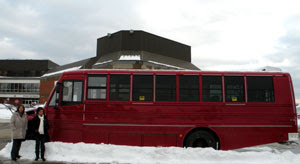
Hains, Kelly and Acevedo have consulted with more than a dozen industry experts across Canada. They say that everyone they have spoken to, "from the Atlantic Tire Dealers Association to Girardin Minibus QC, (the company that manufactures the MFAV body) says that these type of vehicles need winter tires in winter, and by winter tires we mean the kind with a snowflake and mountain pictograph stamped into the rubber."
Leading Experts Agree
The three mothers have the support of John Mahler, an automotive journalist who specializes in tires, and Nigel Mortimer, one of Canada's leading winter tire experts who works with Transport Canada.
Mahler writes for the Toronto Star's Wheels Magazine. He says that changing the front tires on the 21 passenger MFAV to all seasons has not improved the vehicle from a safety piont of view.
"They have changed from one brand of all-seasons to another brand. Both are considered "ribbed tires" with the new Goodyear having slightly bigger rain grooves," explained Mahler in a letter to Hains dated November 6.

Concerning grip, Mahler says "It is conventional wisdom in the tire industry that all-season tires, winter tires and summer tires have the same grip (within a percent or two) at seven degrees above zero. After that as temperatures drop the summer tire loses grip very quickly, the all season tire loses grip slowly and the winter tire's grip increases relative to the other two. So as temperatures drop, the MFAV in question will have more and more grip in the rear and less and less in the front. This makes the handling of the vehicle very unpredictable."
Mahler warns the driver may find the vehicle "does not react as expected when brakes are applied or the steering wheel turned." He says "Unpredictable vehicle reaction in an emergency situation can lead to a crash."
Minister Can't Afford to Ignore Outside Opinion
Marcella Kelly also lost her 15 year old son Nikki in the Bathurst tragedy. She wants the Minister of Education to listen to outside opinion on this issue rather than relying on one consulting engineer from Fredericton who is in the employ of the Department.
"The Minister cannot afford to ignore the possibility that his expert is wrong, especially when every single expert we spoke to agrees that in winter, that vehicle needs winter tires."
In a letter to Mrs. Hains on Friday, November 13, leading winter tire expert Nigel Mortimer of Transport Canada said that he has spoken with New Brunswick's Ministry of Education and their consulting engineer "in an attempt to educate them in the matter."
While acknowledging that Transport Canada has no jurisdiction in the matter, Mr. Mortimer says "We continue to recomend winter tires in all wheel positions where the tires are available in the recomended size." and concludes by saying "I hope that my work in the matter will have the desired effect."
Hains, Kelly and Acevedo say that they will accept nothing less than a commitment from Minister Hache to a review of expert opinion on the use of winter tires on the Bathurst High School MFAV and the implementation of best practices based on its findings.
"We believe that once the Minister has all the information in front of him he will agree with us that it's in the best interest of children's safety to put the right tires on these 21 passenger MFAVs."
Friday, November 6, 2009
John Mahler Opinion on the use of Winter Tires
John Mahler is a veteran automotive journalist with the Toronto Star's Wheels.ca
We asked his opinion on Bathurst High School's Multi Function Activity Vehicle (MFAV) and the use of all season ribbed tires on the front wheels with winter tires on the back. When we wrote to him about the tires, the Department of Transportation had just changed the all season tires on the front to another brand after we complained about the use of all season on the front tires.
This is what Johh Mahler said:
The changing of the front tires on the mini-bus has not improved the vehicle from a safety piont of view. They have changed from one brand of all-seasons to another brand. Both are considered "ribbed tires" with the new Goodyear having slightly bigger rain grooves.
Concerning grip: it is conventional wisdom in the tire industry that all-season tires, winter tires and summer tires have the same grip (within a percent or two) at 7 degrees above zero. After that as temperatures drop the summer tire looses grip very quickly, the all season tire looses grip slowly and the winter tire's grip increases relative to the other two.
So as temperatures drop, the mini-bus in question will have more and more grip in the rear and less and less in the front. This makes the handling of the vehicle very unpredictable. That means the driver may find the vehicle does do react as expected when brakes are applied or the steering wheel turned. Unpredictable vehicle reaction in an emergency situation can lead to a crash.
John also gave us this quote from an article he wrote on the use of winter tires several years ago:
Copy of an item in my column from a few years ago:
You need four good winter tires. This has been the generally accepted practice in the industry for a number of years. Most reputable tire shops will refuse to install just two winter tires for fear of liability if the car is involved in an accident. So I would be suspect of dealing with the shop that recommended installing just two tires.
The reasoning is simple: you want all four corners of the car to work together in an emergency. That means having the same handling characteristics, so that you can brake, steer, accelerate and have equal lateral grip.
Were you to install just two tires on the rear drive wheels, you would have traction to go, but the front tires would lock up sooner than the rears under braking, so you would lose all steering control. If you install the two tires on the front only, you would not have much traction and under braking the rear tires would lock up first and the car would slew sideways and spin. General cornering would make the car understeer (go wide) if the winter tires were on the rear and oversteer (tail comes out) if the winter tires were on the front. Neither scenario makes for safe driving.
We asked his opinion on Bathurst High School's Multi Function Activity Vehicle (MFAV) and the use of all season ribbed tires on the front wheels with winter tires on the back. When we wrote to him about the tires, the Department of Transportation had just changed the all season tires on the front to another brand after we complained about the use of all season on the front tires.
This is what Johh Mahler said:
The changing of the front tires on the mini-bus has not improved the vehicle from a safety piont of view. They have changed from one brand of all-seasons to another brand. Both are considered "ribbed tires" with the new Goodyear having slightly bigger rain grooves.
Concerning grip: it is conventional wisdom in the tire industry that all-season tires, winter tires and summer tires have the same grip (within a percent or two) at 7 degrees above zero. After that as temperatures drop the summer tire looses grip very quickly, the all season tire looses grip slowly and the winter tire's grip increases relative to the other two.
So as temperatures drop, the mini-bus in question will have more and more grip in the rear and less and less in the front. This makes the handling of the vehicle very unpredictable. That means the driver may find the vehicle does do react as expected when brakes are applied or the steering wheel turned. Unpredictable vehicle reaction in an emergency situation can lead to a crash.
John also gave us this quote from an article he wrote on the use of winter tires several years ago:
Copy of an item in my column from a few years ago:
You need four good winter tires. This has been the generally accepted practice in the industry for a number of years. Most reputable tire shops will refuse to install just two winter tires for fear of liability if the car is involved in an accident. So I would be suspect of dealing with the shop that recommended installing just two tires.
The reasoning is simple: you want all four corners of the car to work together in an emergency. That means having the same handling characteristics, so that you can brake, steer, accelerate and have equal lateral grip.
Were you to install just two tires on the rear drive wheels, you would have traction to go, but the front tires would lock up sooner than the rears under braking, so you would lose all steering control. If you install the two tires on the front only, you would not have much traction and under braking the rear tires would lock up first and the car would slew sideways and spin. General cornering would make the car understeer (go wide) if the winter tires were on the rear and oversteer (tail comes out) if the winter tires were on the front. Neither scenario makes for safe driving.
Wednesday, November 4, 2009
Canada's Leading Winter Tire Expert Tells Department the Tires on MFVA are WRONG and Policy Should be Changed
From: Mortimer, Nigel
To: McLaughlin, John (ED15)
Cc: Isabelle Hains; Haché, Roland (Hon) (ED)
Sent: Tue Nov 03 12:14:56 2009
Hi John,
I have been in contact with Isabel Hains who informs me that she has been in contact with you regarding the use of winter tires on the one ton multi functional activity vehicle which is currently equipped with Nokian winter tires on the rear only.
She informs that your school board policy prescribes rib tires on the front and traction tires on the rear for yellow school buses and that this policy is being used on these one ton multi function activity vehicles as well as the large school buses.
Transport Canada highly recomends the use of winter tires, designated with the mountain snowflake symbol, on all wheel positions when such tires are available in the prescribed tire size.
Since these MFAV's currently have all season tires on the front and winter tires on the rear we highly recommend that the same Nokian tires be installed on the front as well as the rear. This will improve vehicle stability, steerability and braking in winter conditions.
The reason that I have been asked to comment on this is that I produced a series of winter tire demonstration videos, teach winter driving skills, and sit on an advisory comitee with the Rubber Association of Canada. Our comitee will shortly be regulating the use of the mountain snowflake symbol here in Canada. Additionally we are looking into regulating ice traction as well as the current snow traction requirements prescribed by this mountain snowflake symbol.
Sincerely,
Nigel Mortimer
Head of Recalls
Road Safety Department
Transport Canada
Here is John McLaughlin's extremely swift response to Nigel Mortimer's letter (less than 12 minutes given the one hour time difference between Ontario and New Brunswick).
From: McLaughlin, John (ED15)
Sent: November 3, 2009 11:26 AM
To: Mortimer, Nigel
Cc: Isabelle Hains; Haché, Roland (Hon) (ED)
Hello Nigel,
Thank you for the email. Our district follows the protocol established by the Department of Education under its new Policy 513.
I will forward your email to the appropriate people at the Department of Education. We take our direction from that level.
Thanks again for the email. This issue is of great concern to all of us as student safety is of the highest importance.
Sincerely,
John McLaughlin
Superintendent
School District 15
--------------------------
John M
And here is Nigel's follow up email to John McLaughlin
From: Mortimer, Nigel
To: McLaughlin, John (ED15)
Cc: Isabelle Hains ; Haché, Roland (Hon) (ED)
Sent: Tuesday, November 03, 2009 2:17 PM
Thanks John,
Hopefully the policy will be changed as a result of our experience in this matter.
Nigel Mortimer
Head of Recalls
Road Safety Department
Transport Canada
To: McLaughlin, John (ED15)
Cc: Isabelle Hains; Haché, Roland (Hon) (ED)
Sent: Tue Nov 03 12:14:56 2009
Hi John,
I have been in contact with Isabel Hains who informs me that she has been in contact with you regarding the use of winter tires on the one ton multi functional activity vehicle which is currently equipped with Nokian winter tires on the rear only.
She informs that your school board policy prescribes rib tires on the front and traction tires on the rear for yellow school buses and that this policy is being used on these one ton multi function activity vehicles as well as the large school buses.
Transport Canada highly recomends the use of winter tires, designated with the mountain snowflake symbol, on all wheel positions when such tires are available in the prescribed tire size.
Since these MFAV's currently have all season tires on the front and winter tires on the rear we highly recommend that the same Nokian tires be installed on the front as well as the rear. This will improve vehicle stability, steerability and braking in winter conditions.
The reason that I have been asked to comment on this is that I produced a series of winter tire demonstration videos, teach winter driving skills, and sit on an advisory comitee with the Rubber Association of Canada. Our comitee will shortly be regulating the use of the mountain snowflake symbol here in Canada. Additionally we are looking into regulating ice traction as well as the current snow traction requirements prescribed by this mountain snowflake symbol.
Sincerely,
Nigel Mortimer
Head of Recalls
Road Safety Department
Transport Canada
Here is John McLaughlin's extremely swift response to Nigel Mortimer's letter (less than 12 minutes given the one hour time difference between Ontario and New Brunswick).
From: McLaughlin, John (ED15)
Sent: November 3, 2009 11:26 AM
To: Mortimer, Nigel
Cc: Isabelle Hains; Haché, Roland (Hon) (ED)
Hello Nigel,
Thank you for the email. Our district follows the protocol established by the Department of Education under its new Policy 513.
I will forward your email to the appropriate people at the Department of Education. We take our direction from that level.
Thanks again for the email. This issue is of great concern to all of us as student safety is of the highest importance.
Sincerely,
John McLaughlin
Superintendent
School District 15
--------------------------
John M
And here is Nigel's follow up email to John McLaughlin
From: Mortimer, Nigel
To: McLaughlin, John (ED15)
Cc: Isabelle Hains ; Haché, Roland (Hon) (ED)
Sent: Tuesday, November 03, 2009 2:17 PM
Thanks John,
Hopefully the policy will be changed as a result of our experience in this matter.
Nigel Mortimer
Head of Recalls
Road Safety Department
Transport Canada
Subscribe to:
Posts (Atom)


